Posts

Showing posts with the label Solar Capital

Education and excellence keys to success for women in business
Image
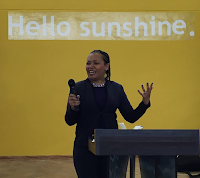
Makole Mupita It has been 60 years since the 1956 Women’s March to the Union Buildings. Since then a tremendous amount of positive change has occurred in South Africa - both politically and more specifically in the sphere of gender politics. As a country, we have been lauded for our progressive constitution, but women are still under-represented in leadership positions. A survey released by Grant Thornton in 2016 showed that leadership positions held by women decreased from 27% in 2015 to 26% in 2016. This is according to Makole Mupita, co-founder and Executive Director of Mahlako a Phahla Investments -  a women-led company focused within the energy and infrastructure sectors. Speaking at a recent Women’s Month event held in De Aar in the Northern Cape by Solar Capital - who recently launched the largest solar farm in the Southern Hemisphere, Mupita shared her views on how to encourage the increase of women in business and women entrepreneurs. In her speech, Mupita reinforced...

Youth day highlights need to invest in entrepreneurial development

Image
The unemployment rate in South Africa was estimated at 26.7% in March 2016, a significant increase from 24.5% in the first quarter of the year – according to Statistics South Africa. Youth Day, which is acknowledged annually on the 16 June, highlights the need for Corporate South Africa to invest in skills development and entrepreneurial training in order to address the pressing issue of unemployment among the youth. This is according to Janice Finlay, Head of Economic Development at Solar Capital - a leading solar plant developer that recently launched the largest solar farm in the Southern Hemisphere - who says that unemployment among South African youth is not only a pressing social issue, but is also a major obstacle standing in the way of economic growth in the country. “To address this issue, Solar Capital recently started its Solar Capital Enterprise Development Youth Programme, which aims to create start-up businesses that will be owned and run by 16 local youngsters between t...

Solar Power – The green and clean energy we need in SA

Image
The environmental change sweeping our world is happening at a rate far faster than previously imagined, concluded the Global Environmental Outlook (GEO-6) study carried out by United Nations Environment Programme (UNEP) this year. With a focus on protecting the environment during World Environment Day, 01 June 2016, the move towards the provision of renewable energy through the South African Renewable Energy Independent Power Producer Procurement (REIPPP) Programme has been lauded for assisting in the reversion of the worst impacts of climate change, as recognised by the UNEP. According to Paschal Phelan, Chairman of Solar Capital, renewable energy in general, and solar power specifically, allows for a reduction in the reliance on fossil fuels - while also providing a far superior option in terms of protecting the environment. “The production of solar energy has minimal CO² emissions, little water usage, is inexhaustible, and it is safe.” Phelan explains that global electricity produ...

Are SA businesses doing enough to give back?

Image
Janet Matthee Are businesses doing enough to give back to the communities in which they work? This has been a question that many South African companies have faced since Corporate Social Investment (CSI) programmes became more widespread and formalised in the country. The answers haven’t always been favourable. The findings of Anglo American’s R100m investment into education between 2010 and 2014 are a great example of how CSI programmes can be inneffective in reaching set objectives[2]. This is according to Paschal Phelan, Chairman of Solar Capital – developers of the largest solar farm in the Southern Hemisphere – who says that the success of a company is not simply down to intelligent business models, but that it also relates to meaningful interaction within the community affected by the business, as well as investment into sustainable, developmental projects with positive long-term effects. “Too many companies’ CSI programmes remain on the periphery of their business objective...